Is the Printed Word Dead?

Ink and paper is dead. Long live the e-book.

This day has been dreaded by publishers and authors for a decade now. Much like the passing of a cherished relative, denial is inevitable, publishers in particular. But the printed book’s death rattle is obvious for those who are paying attention to the e-book craze. Will printed books disappear completely? No, but the familiar shelves at bookstores and airports will go the way of vinyl records: relegated to collectors and aficionados with breathless whispers of a comeback.
Still not convinced? Consider these recent developments: The share of adults in the United States owning either a tablet or an e-book recently jumped from 18% in December of 2011 to 39% in January of 2012. That’s a doubling of product penetration in one month, fueled by the holiday gift season. The adoption of smartphones is even more pervasive. According to Neilson’s third quarter 2011 Mobile Media Report, over 44 percent of all US mobile phone subscribers now own a smartphone. That’s up from 18 percent, just two years ago. When you look at the prime purchasers, aged 25-34, the number is even larger. Over 62 percent of this age group relies on smartphones for their Web content.
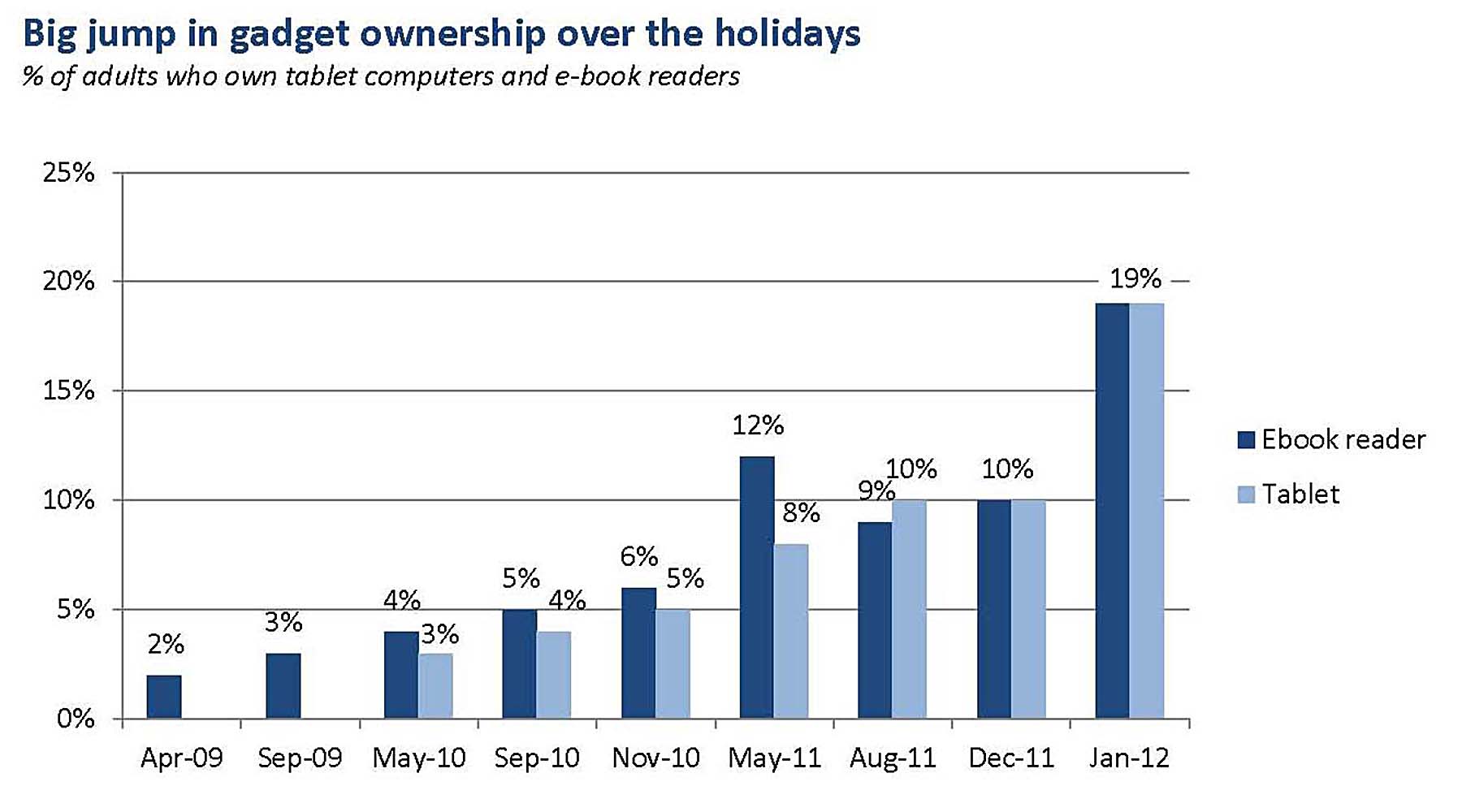
This rapid growth is permanently changing the way that books are distributed, much like the collapse of the traditional music business. Remember the mega-music stores in malls across the country? That was less than a decade ago. They are nowhere to be found today.
Publishers are experiencing a crisis of identity as they struggle to maintain their roles as the gatekeepers of the printed form. The Apple price fixing scandal and its likely repercussions have only increased the angst of the old guard. The uncertainty of the future and the continuing downward pressure on the price of e-books has created a backlash among the big publishers. They are digging in their heels and fortifying their defensive positions.
Aspiring authors are caught in the crossfire. Publishers have focused resources on their established author brands to the exclusion of their mid-list and first-time authors. A few mega-hit authors like James Patterson, Clive Cussler, and J. K. Rawling have become franchises with teams of young, struggling authors helping to turn out multiple books a year, containing little influence of the author, whose name commands the front cover. Even deceased authors like Robert Ludlum have mysteriously returned from the grave to pen more tomes through the restorative magic of imaginative publishing houses.
Ironically, this retreat of support only encourages new authors to abandon traditional channels and move their works directly to the web. Why endure shrinking ad budgets and royalties when it’s far easier and faster to simply publish original works through digital houses like Amazon’s CreateSpace or Lulu? Self publishing isn’t necessarily a panacea—authors must become their own marketing, public relations, and distribution organizations—but with publishers abandoning these roles even for their own authors, what are the alternatives? If we must take on these roles anyway, why not reap the benefit of higher royalties and publishing schedules measured in days vs. months?
Most authors would rather focus on their primary craft—writing—and leave the marketing and distribution to the publishers. So, are publishers really making a smart move here? If they base their entire profit model on aging author franchises, what happens when those franchises die or retire? Who takes their place, if new authors have already left for the web? Are we doomed to read mass produced Ludlum clones forever?
I seriously doubt it. Publishers will either adapt to this new environment, or they will go extinct. Either way, authors must rethink our roles in the new digital marketplace.
Should we bother to shed a tear for the passing of the dog-eared paperback and leather-bound tome? Printed books don’t possess some magical ability to educate and entertain. In fact, as a story-telling medium, books have a short history. We often forget, that for the majority of human existence, oral traditions passed on stories, myths, and ideas through the generations. Role playing and acting did the same. This Youtube “digital” tale provides a humorous look at the author’s angst over the passing of a beloved oratorical tradition:
Writing is about ideas, and authors should reimagine themselves as Idea Delivery Specialists, not as writers of the printed word. As the humorous story points out, there will always be an adjustment period when traditions change, but the advent of e-Books and tablets offers the opportunity to reinvigorate the transmission of ideas, our primary product. Authors as idea brokers, are back. We control the message and the medium.If you are an established author, you will eventually have to embrace this new medium. Better now than later.

Kent Lester writes fiction and non-fiction in a variety of subjects, including science, construction, the art of writing, social media, the Drupal content management system, complexity science, and the future. This blog may contain posts on some or all of these subjects.
Recent content
- 4 days 8 hours ago
- 5 years ago
- 5 years 4 months ago
- 5 years 4 months ago
- 5 years 4 months ago
- 5 years ago
- 5 years ago
- 5 years ago
- 5 years 6 months ago
- 5 years 6 months ago
Archives
- December 2015 (1)
- June 2016 (1)
- February 2017 (3)
- April 2017 (6)
- September 2022 (1)
Copyright 2017 by Kent Lester